
Difference Between D2C and B2C: The Evolution of Ecommerce
Updated on September 23, 2026
Table of Contents
ToggleD2C and B2C get thrown around like the same word. They’re not. And the gap between them, D2C vs B2C, decides who owns your customer, where your margin lands, and how much of the work falls on you. Quick version: a D2C brand makes its own stuff and sells it straight to you. B2C is the bigger bucket, selling to shoppers however you can, usually with a store or a marketplace sitting in the middle. Control on one side. Reach on the other.
Neither one wins by default, and loads of brands do both. So skip the theory. Below is what each model actually is, where each one earns its spot, and what the choice does to your marketing, your data, and your D2C fulfillment once real orders start landing.
What D2C vs B2C Really Means for a Growing Ecommerce Brand
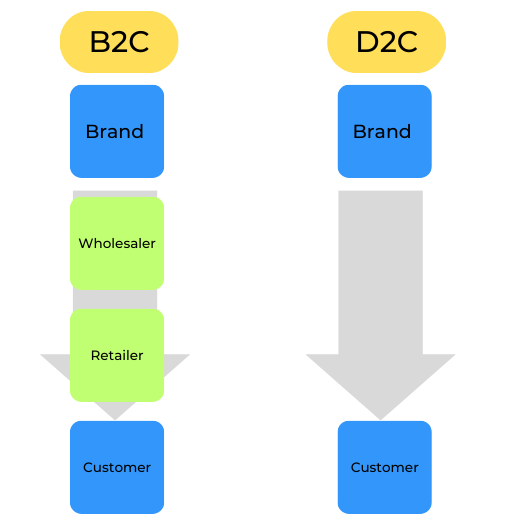
The words trip people first, so start there. B2C just means a business selling to a regular shopper. Could be a huge retailer, a marketplace, a corner store, or a brand’s own site. D2C vs B2C narrows to one case: the brand made the thing and sells it to you with nobody in the middle.
That’s why they aren’t opposites. Every D2C brand is B2C, but not every B2C brand is D2C. A grocery store stacking other people’s brands? B2C. Gymshark, designing its own gear and selling it on its own site? D2C. One line splits them: do you own the product and the customer, or does a middleman?
Quick gut check. Could you yank the retailer out and still sell the same product to the same person? Then you’re basically D2C already. Lean on someone else’s store or marketplace to reach the buyer? That’s B2C. Plenty of brands sit in both, and that’s fine.
The Real Upsides, and Costs, of Selling Direct to Consumers
Direct selling is booming, and the money explains why. US D2C sales were headed for about $240 billion in 2025, roughly a fifth of all retail ecommerce. Drop the retailer and you pocket the markup you used to hand them. You also keep the customer data instead of borrowing scraps of it.
But direct hands you every job the retailer used to do. That’s the whole tension in D2C vs B2C. Now you run the site, buy the ads, answer the tickets, and ship the boxes. Better margin per order, sure. You just paid for it with time, cash, and the risk of finding every customer yourself. More control, more work. That’s the deal.
None of that makes direct a trap. It just means going direct is a commitment, not a switch you flip. The brands that win at it treat marketing and fulfillment as real work, not afterthoughts, and they budget for both from day one. Go in expecting the workload and it pays off. Go in expecting easy money and it bites.
Why the B2C Model Still Wins on Reach, Trust, and Scale?
Easy to hype direct selling and forget the obvious: B2C is still where most sales happen. In the D2C vs B2C split, the big retailers and marketplaces bring something you can’t fake on day one. Reach. Trust. Get on a marketplace or onto a shelf and you’re in front of millions who already trust that place. You didn’t have to earn it.
The price of that reach is control. You hand over some margin and part of the relationship, but you skip years of clawing an audience out of nowhere. For a lot of products, a commodity, an impulse grab, something people just want now, showing up where they already shop beats begging them to find your site.
B2C spreads your risk, too. If a marketplace or a chain carries you, one slow channel doesn’t sink the month. The flip side: you’re renting the relationship. The platform owns the customer, writes the rules, and can hike fees or bury your ranking whenever it feels like it.
D2C vs B2C: The Core Differences That Shape How You Sell
Line them up and D2C vs B2C breaks along a few seams: who’s in the middle, who keeps the data, and where the margin goes. Here’s the short version.
|
Factor |
D2C |
B2C |
|
Who sits in the middle |
Nobody, you sell direct |
Usually a retailer or marketplace |
|
Customer relationship |
Owned by you |
Shared with, or held by, the middleman |
|
Customer data |
First-party, yours to keep |
Limited, often the retailer’s |
|
Margin per sale |
Higher, no wholesale cut |
Lower, you sell in at a discount |
|
Reach |
Built by you, slower to grow |
Instant, through established channels |
|
Marketing |
You drive all of it |
Partly carried by the channel |
|
Best for |
Brands with a story and loyal buyers |
Commodity or impulse buys, broad reach |
Don’t read it as a winner and a loser. It’s trade-offs. Direct wins on control, data, and margin. B2C wins on reach and on not having to build everything yourself. Which side matters more is entirely about what you sell and how you plan to grow.
How D2C, B2C, and B2B All Fit Together in Modern Ecommerce
Add the third model and D2C vs B2C suddenly makes more sense. B2B is selling to other businesses, usually bulk, usually wholesale. B2C and D2C both sell to the shopper; the only fork is whether a middleman’s involved. And most brands don’t pick one. They end up in two or three at once.
That mix is normal, and often the smart play. Brands running both direct and wholesale tend to scale faster than the ones stuck in a single lane. Sell D2C on your site, use a marketplace for B2C reach, wholesale to a few retailers on the side. The hard part isn’t running them. It’s keeping the story and the stock straight across all of them.
That last bit is harder than it sounds. Same SKU on your site, on a marketplace, and with a wholesale buyer means three sets of expectations pulling from one pile of stock. Miss the sync and you oversell one channel while dead stock piles up in another. It’s why growing brands lean on one system, and one fulfillment partner, to hold it together.
What Each Model Means for Your Fulfillment and Shipping
D2C vs B2C isn’t just a marketing call. It hits the warehouse floor. Direct usually means a river of small parcels going to front doors, branded, fast, and judged one order at a time. B2C through a retailer flips that: fewer, bigger shipments into their DCs, packed and labeled by their rules, not yours.
Two different jobs. Direct orders want ecommerce fulfillment tuned for high-volume, one-at-a-time picking and a box worth photographing. Retail wants retail fulfillment that hits strict routing and compliance, or eats a chargeback. Run both and you need a partner who can flip between them without fumbling either.
Get that wrong and it shows up fast. Direct orders start trickling out late and the reviews turn. Or a retailer dings you with a compliance chargeback over a label an inch off spec. The model you pick quietly writes the rules your warehouse lives by, so it’s worth sorting out before the volume lands.
How to Decide Between a D2C vs B2C Service for Your Ecommerce Brand
No clean answer to D2C vs B2C. It comes down to your product, your margins, and how much you actually want to own. Got a product with a story, a following, or margins fat enough to fund your own ads? Direct tends to pay off. Selling a commodity, or something people expect to grab on Amazon? Reach probably wins.
Be straight with yourself about capacity, too. Direct rewards brands that can run their own ads, support, and shipping well. B2C leans on partners to carry it. And almost nobody picks once and stops. You start where you can win, then add the other lane as you grow. For the direct side, our guide to D2C fulfillment digs in; for the wholesale angle, the B2B vs B2C fulfillment breakdown covers it.
And it’s not a forever decision. Markets move. A product pops. A retailer emails out of nowhere. What’s smart a year from now might not fit today. Pick the model that gets you traction now, watch the numbers, and add or cut a channel when the data says so.
Where a Fulfillment Partner Fits, Whichever Model You Pick
Whichever way you go on D2C vs B2C, the orders still have to ship. That’s where a strategy turns into daily grind. A 3PL holds your stock and runs the picking, packing, and shipping, direct, retail, or both, so you can switch or blend channels without tearing down your operation every time you change your mind.
That’s the point of working with Phase V. We run direct and retail side by side, keep one honest view of inventory across every channel, and grow with you as the mix moves. You decide which model to chase. We get the orders out right either way, fast, branded parcels to your buyers and clean, compliant loads to your retail accounts, from one operation.
| Work with Phase V.
However the D2C vs B2C call shakes out, both, or somewhere in between, fulfillment shouldn’t be the thing that slows you down. Phase V handles the storing, picking, packing, and shipping for direct and retail orders alike, so you can chase whichever model grows the brand. Get in touch with our team and build fulfillment that bends with your strategy instead of boxing it in. |


